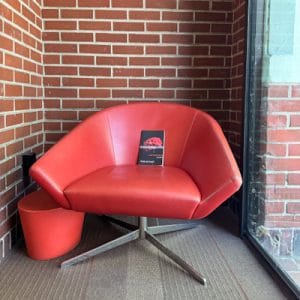
It wasn’t so much a journey as it was whether or not I thought it was worth publishing.
red carnation began with a dream. No, really, a dream. Not a lofty one–a literal one. One that happens in the middle of the night or in the wee hours of the morning when we are all unconscious, heads on pillows, wandering the universe. Experiencing life in another realm. The stories from there are just as real as the stories from this one, the one we live awake in.
I kept these dream-state stories in journals.
My major course of study in university was in the visual arts. In the background, it took me decades to learn how to write. To find my voice. It took me decades to learn that how I write is writing.
The only reason I remember that I started red carnation twenty-six years ago was because I remember where I was working that year–and that I told the red carnation story to a co-worker at the time and we had a very long conversation about it.
In its first incarnation, it was a short story that I broke up into the first three or four chapters. They ended up on my creative writing blog as a novel experiment series of posts. Nothing more. It also sat and spun on my hard drive, existing as a document hidden in a folder, within a folder, for many years.
Then, in 2013 I took it out, dusted it off, and attempted to write more of it during a NaNoWriMo sprint. While I received a lot of encouragement and good reviews from the people in my group, I couldn’t finish it. Something was missing. Yes, what was missing were the last ten chapters. In going back to my dream journals, I realized that there was much more to this story of the red carnation. The flower had appeared in a number of dreams over a short period of time. I had to sit with those for awhile before I saw the non-linear thread weaving through them. It was a challenge to write them out as one story. After the sprint, the book went back to hiding on the hard drive. Until recently.
I had been working on my first big novel for about a year when I realized I needed a break from writing it–but I didn’t want to stop writing altogether. I pulled red carnation out again, from the dust on the hard drive, and read through it. Potential. But it needed editing. My writing style had changed a little over the years.
I also thought that going through the process of publishing a smaller work would be good practice for publishing the big book later, when it was finished.
At the end of this past April, in 2026, I started editing, thinking that it would only take two-weeks at most. Here it is, three months later, and I’ve finally finished it!
It’s been an amazing process–to go from non-attachment to nitpicking every little edit until it sounded right when I read it to myself. Very much the opposite of my normal creative process of working towards non-attachment. The coolest thing was listening to some of it on audio, which gave me a completely different perspective on the story.
I think my message here, for new writers, is: keep writing, no matter how long it takes. Stories have their own sense of timing. Sometimes they aren’t waiting to be written–they’re waiting for the writer to be ready.